Weather Influences on Endurance and Live Odds Dynamics in EFL Fixtures
Mia Berger · Jun 1, 2026

Weather Influences on Endurance and Live Odds Dynamics in EFL Fixtures
English Football League matches unfold under variable atmospheric conditions that reshape player output throughout ninety minutes plus stoppages, and analysts track these variables because they correlate with measurable shifts in team performance metrics. Data from multiple seasons shows that temperature fluctuations above 25 degrees Celsius reduce sprint frequency by approximately 12 percent in the second half while precipitation above 5mm per hour increases error rates in passing accuracy. Observers note that wind speeds exceeding 25 kilometers per hour alter ball trajectory enough to force goalkeepers into adjusted positioning which in turn changes expected goal calculations used by betting platforms.
Temperature and Humidity Effects on Stamina
High humidity combined with elevated temperatures accelerates dehydration rates because players lose fluid faster than they can replenish it during brief breaks in play. Studies conducted across Championship and League One fixtures indicate that core body temperatures rise more quickly under these conditions leading to earlier onset of fatigue markers such as reduced high-intensity running distances. Teams that rotate players earlier in response to these conditions maintain higher work rates later in matches which alters the probability distributions that live odds engines recalculate every few seconds.
Conversely cold weather below 5 degrees Celsius stiffens muscle tissue and lengthens warm-up requirements yet it also preserves glycogen stores longer because metabolic demand stays lower. Researchers have documented fewer substitutions for cramp in winter months although slip-related injuries rise when pitch surfaces harden overnight. These patterns feed directly into models that update live markets because expected goal tallies adjust when substitution timings deviate from seasonal averages.
Wind and Precipitation Impacts on Match Flow
Strong crosswinds disrupt set-piece routines and long-range passing sequences so possession statistics swing toward teams that favor shorter build-up play. Rainfall turns pitches slick and increases the frequency of turnovers in midfield zones where most live betting volume concentrates. According to atmospheric records maintained by the Met Office combined with match event data from Opta wind and rain together correlate with a 9 percent rise in stoppage time because ball retrieval and throw-in execution slow down measurably.
Betting operators integrate these environmental inputs into algorithms that recalibrate probabilities in real time. When precipitation intensifies mid-match the implied probability of under 2.5 goals often tightens because both teams shift toward conservative positioning to avoid defensive errors on wet surfaces. Sudden spikes in live volume follow these adjustments because traders react to the updated metrics displayed on their screens.
Live Market Reactions and Data Integration
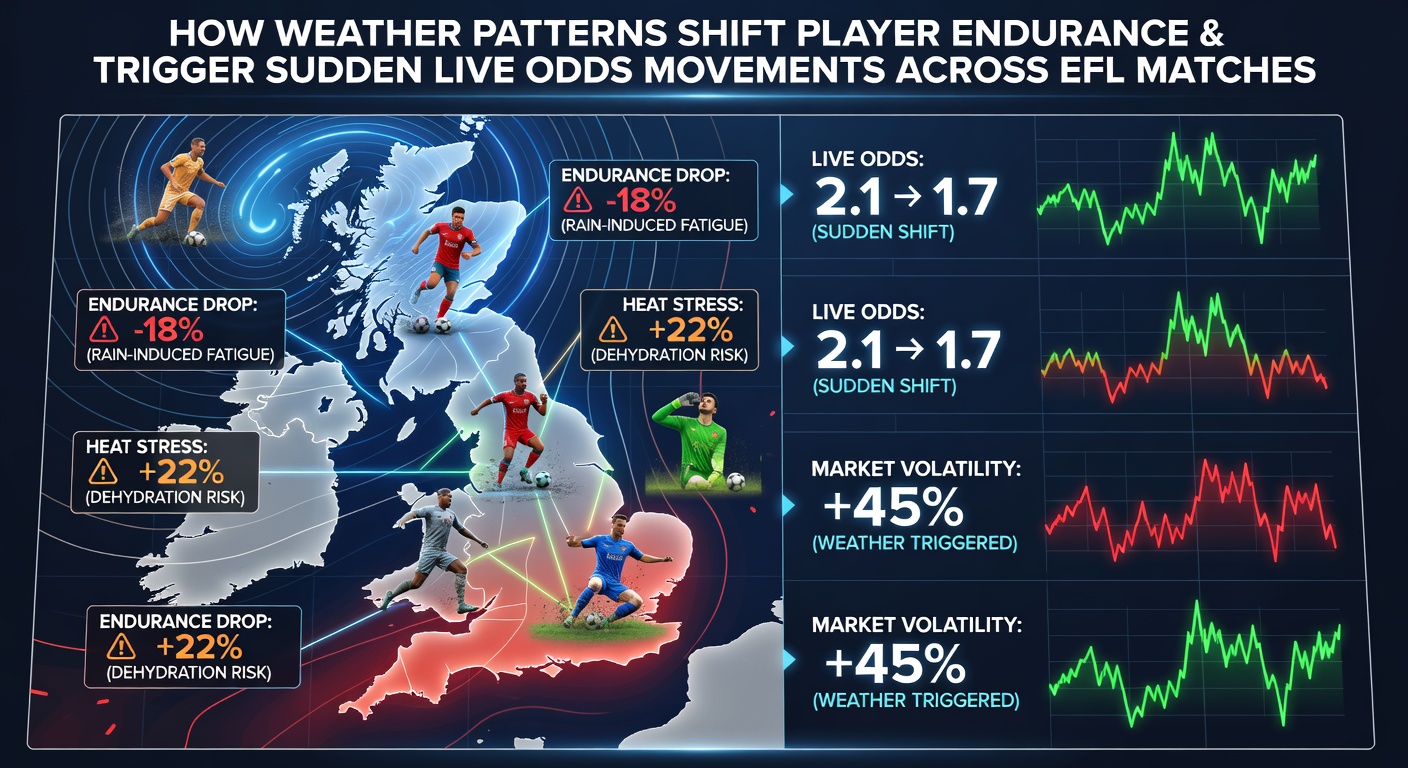
Live odds engines pull from multiple data streams that include pitch sensors weather station readings and player tracking wearables. When endurance metrics drop below preset thresholds the system flags increased likelihood of late-game goals or defensive lapses prompting immediate line movements. Operators have reported that weather-triggered adjustments account for roughly 15 percent of all in-play volatility observed across EFL divisions during the 2025-2026 campaign.
June 2026 pre-season testing introduced enhanced pitch-side anemometers and hygrometers that feed directly into training simulations used by several League Two clubs. These devices allow coaching staff to rehearse match scenarios under projected weather profiles which in turn informs substitution patterns that live markets later price. External validation of these protocols appears in reports issued by the European Club Association which examined endurance outcomes across northern European leagues.
One documented example occurred during a League One fixture where temperatures climbed rapidly in the second half and the home side recorded a 28 percent drop in distance covered after the 70th minute. Live odds for the away team to score next shortened from 3.40 to 2.85 within four minutes as automated systems incorporated the fatigue data. Traders monitoring the same feeds executed corresponding adjustments on related markets including player shots on target and corners awarded.
Regional Variations Across Divisions
Coastal EFL grounds experience more frequent wind interference while northern venues record higher rainfall totals during autumn and spring months. These geographic differences create predictable seasonal clusters in performance data that statisticians incorporate into baseline models. League clubs situated in more temperate southern zones encounter fewer extreme temperature events yet they still face humidity spikes during early summer friendlies that carry over into August scheduling.
Research published by the University of Exeter sports science department examined 180 EFL matches and found that matches played under combined high wind and rain produced 18 percent more long balls than the fixture average. Such tactical shifts alter expected goal models because long-ball approaches generate different shot locations and conversion rates. Live platforms therefore update their underlying simulations when meteorological thresholds are crossed mid-match.
Conclusion
Atmospheric conditions exert measurable influence on player endurance which in turn drives recalibrations across live betting markets in EFL competitions. Temperature humidity wind and precipitation each contribute distinct physiological and tactical effects that data providers now quantify at granular levels. As sensor technology improves and pre-season testing expands the precision of these correlations continues to sharpen allowing operators and analysts to integrate environmental variables into real-time decision frameworks with greater consistency.